Moving Expense Tax Deduction in Canada: What Can You Claim?
Moving for a new job, relocating your business, or moving closer to a new workplace can get expensive quickly. Between movers, transportation and storage costs, temporary accommodations, legal or notary fees, and other relocation related costs, the final bill can be much higher than expected.
Work-related relocation is also a meaningful reason Canadians move. According to Statistics Canada’s 2026 analysis of the Canadian Housing Survey, 42.5% of households that moved between provinces cited employment, including a new job or job transfer, as a reason for moving. The same study found that one-third, or 33.3%, of Canadian households had moved to their current residence within the previous five years.
The good news is that some of those costs may qualify for a moving expense tax deduction in Canada. So, what can you claim?
For Azim Dahya, CPA, understanding the rules before filing matters:
Moving expenses can involve more tax considerations than people expect. Knowing which costs qualify and how they connect to your new source of income will help you claim the deduction accurately and avoid leaving eligible expenses behind.
Let’s look at when moving expenses are deductible, which relocation costs the Canada Revenue Agency accepts, and how to claim them correctly on your Canadian tax return.
Are Moving Expenses Tax Deductible in Canada?
Yes, moving expenses can be tax deductible in Canada, but your relocation must meet CRA eligibility requirements.
If you are employed or self-employed and move within Canada, you can claim eligible expenses when:
- You moved to work or operate a business at a new location.
- You earned employment or self-employment income at the new location.
- You established a new home.
- Your new home is at least 40 kilometres closer to your new work location than your previous home was.
The CRA measures that distance using the shortest public route.
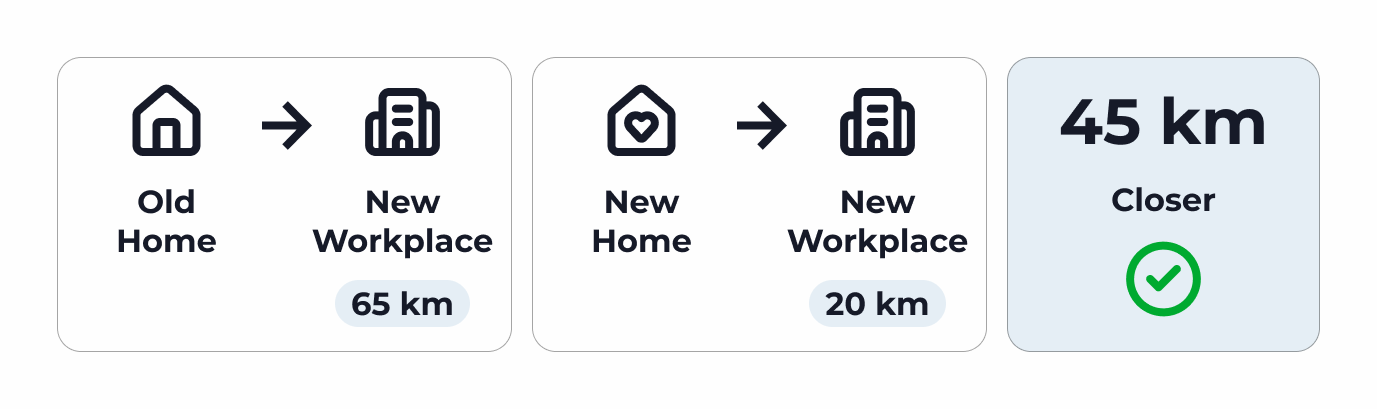
For example, suppose your old home was 65 kilometres from your new workplace. After relocating, your new home is 20 kilometres away.
The difference is 45 kilometres.
Because the new home is at least 40 kilometres closer to the new workplace, the move may satisfy the distance requirement, provided the other eligibility requirements are also met.
Other Contexts to Consider When Applying the Moving Expense Tax Deduction
The CRA applies similar rules to qualifying full-time post-secondary students, although the income against which students can deduct their expenses is different. The CRA also confirms that students who move to work, including for summer employment, may claim qualifying moving expenses against employment income earned at the new work location.
There are also special rules for certain Canadian residents moving to Canada, leaving Canada, or moving between locations outside Canada.
Most importantly, moving expenses are not simply a deduction against any income you earned during the year.
According to the CRA’s moving expense rules, employees and self-employed individuals claim eligible expenses against employment or self-employment income earned at the new work location, rather than unrelated sources such as investment income or employment insurance benefits.
That distinction can make a significant difference when calculating your deduction and determining whether you are eligible to claim certain relocation costs.
CRA Eligible Relocation Expenses: What Can You Deduct?
Once you determine that your move qualifies, the next question is which expenses you can include.
The CRA recognizes several categories of eligible relocation expenses, but not every cost associated with moving qualifies. If you meet the requirements, you may be able to deduct eligible moving expenses for yourself and qualifying household members who move with you. The CRA specifically notes that not all household members have to travel together or at the same time.
Here is a quick comparison of the CRA eligible relocation expenses:
Eligible Moving Expenses
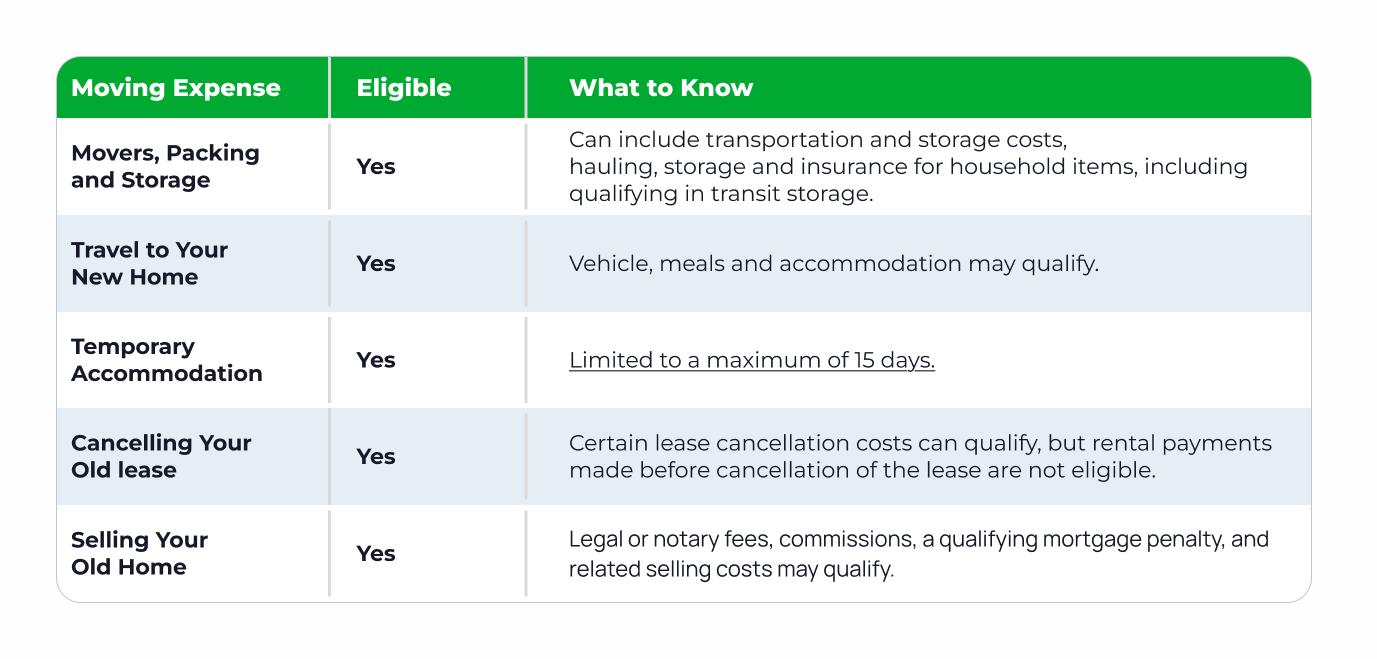
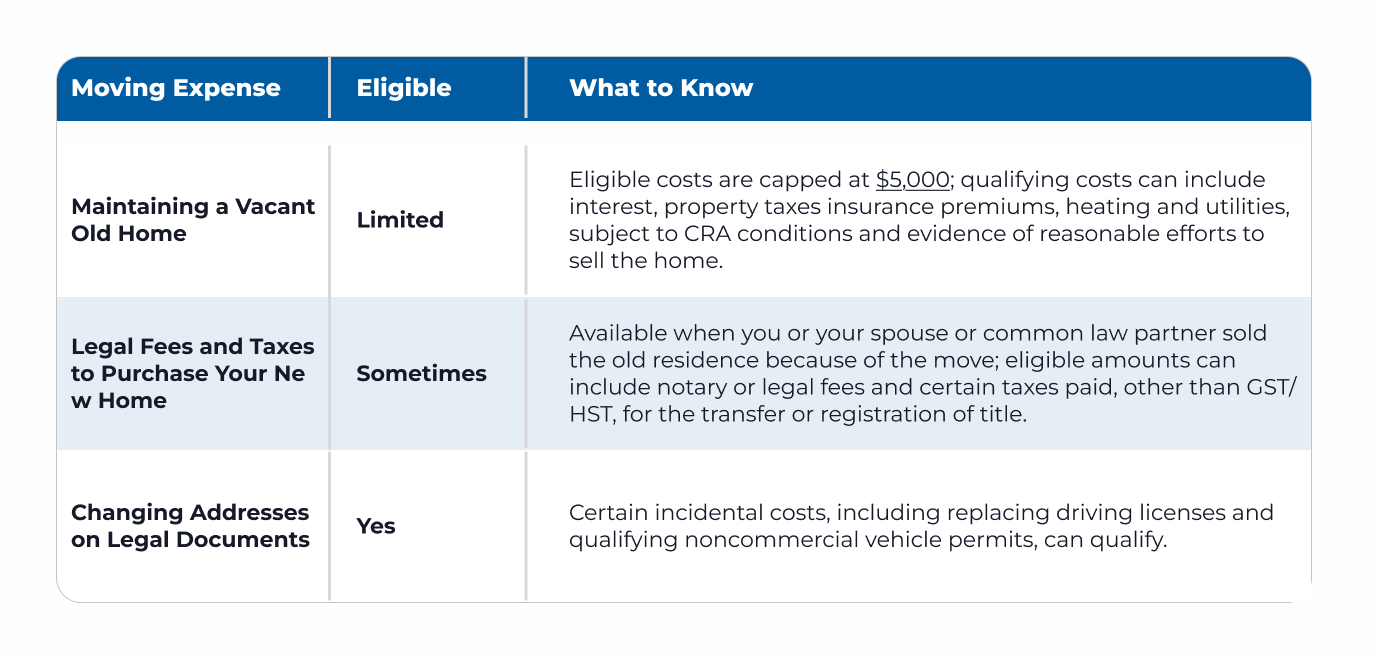
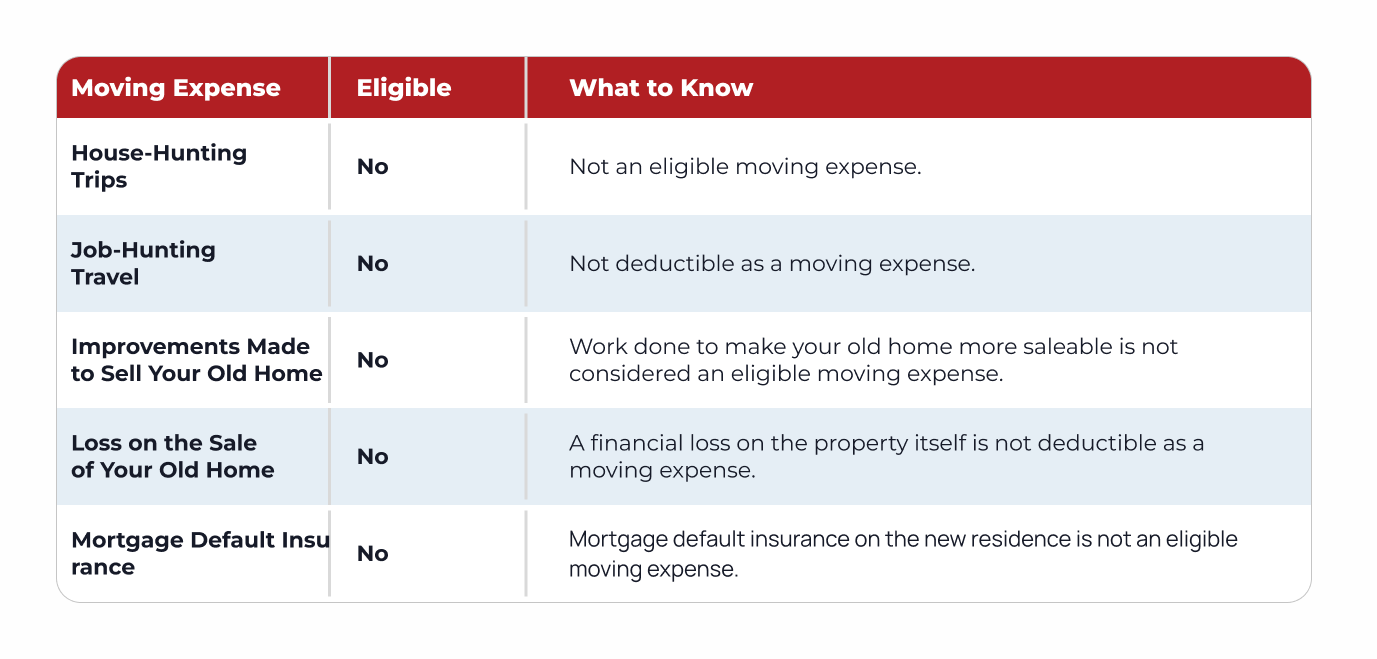
The CRA’s Line 21900 guidance provides the complete list of eligible and ineligible moving expenses. These costs are deductible only while the former home is actively being sold, not if you delay the sale for investment purposes or to wait for the real estate market to improve. Keep receipts or similar support for amounts claimed during that period, including property taxes and insurance premiums. This is particularly important for demonstrating the reasonable efforts made to sell the former residence.
Certain household appliances costs are also specifically restricted. For example, costs of transformers or adaptors for household appliances are specifically listed by the CRA as ineligible. Similarly, household appliances costs incurred simply because of the relocation are not automatically deductible moving expenses.
What About Meals and Vehicle Expenses?
For qualifying meal and vehicle expenses, the CRA allows you to choose between a detailed method and a simplified method.
With the detailed method, you claim your actual costs, or actual expenses, and keep detailed receipts and supporting records for meal expenses and travel expenses. The simplified method uses CRA-established rates instead for vehicle and meal expenses.
For the 2025 tax year, for example, the CRA’s simplified meal rate is $23 per meal, up to $69 per person per day. Simplified vehicle rates vary depending on the province or territory where your travel begins. For 2025, CRA simplified kilometre rates range from 55.5 cents per kilometre in Saskatchewan to 70.5 cents per kilometre in Nunavut and Yukon. Because these rates can change, always use the applicable CRA rate for the tax year you are filing.
Claiming Moving Expenses on Your Canadian Tax Return

Claiming moving expenses involves more than collecting your moving receipts and entering the total on your tax return. Here is how the process works:
1. Confirm That Your Move Qualifies
Start by determining why you moved and whether you meet the applicable 40-kilometre test.
If the move was related to employment or self-employment, you also need to consider any earned employment income or self-employment income at your new work location. Moving expenses cannot be deducted from other income sources such as investment income or employment insurance benefits.
For students, different income rules can apply. A qualifying full-time student, for example, may deduct eligible moving expenses from the portions of scholarships, fellowships, bursaries, certain prizes, or research grants that are required to be included in income. If the student moves to work, including summer employment, the deduction is against qualifying employment or self-employment income earned at the new work location.
2. Separate Eligible from Ineligible Expenses
Review your relocation costs carefully by separating deductible costs from expenses incurred that are not eligible.
Your moving company’s invoice may be eligible, for example, while a house-hunting trip or renovations completed before selling your previous home will not be. You can only claim eligible moving expenses if they were expenses paid or paid moving expenses directly tied to the qualifying move.
This is where keeping organized records can make filing much easier, especially where expenses cover several household members. The CRA confirms that not all household members need to relocate together or at the same time.
3. Account for Employer Reimbursements
Did your employer pay for part of the move? That needs to be considered before claiming your deduction.
If you received an employer reimbursement or allowance for eligible moving expenses, the CRA requires you to either include that amount in your income or reduce your moving expense claim by the amount received.
In other words, you cannot receive a tax-free reimbursement for an expense and then deduct that same expense again.
4. Complete Form T1-M
Eligible taxpayers use Form T1-M, Moving Expenses Deduction for moving expense claims under section 62 of the Income Tax Act to calculate the deduction.
The resulting eligible amount is reported on Line 21900 of your income tax and benefit return. The form also helps determine net eligible income and net moving expenses for the year.
If you had more than one eligible move during the year, the CRA requires a separate Form T1-M for each eligible move.
5. Keep Your Supporting Documents
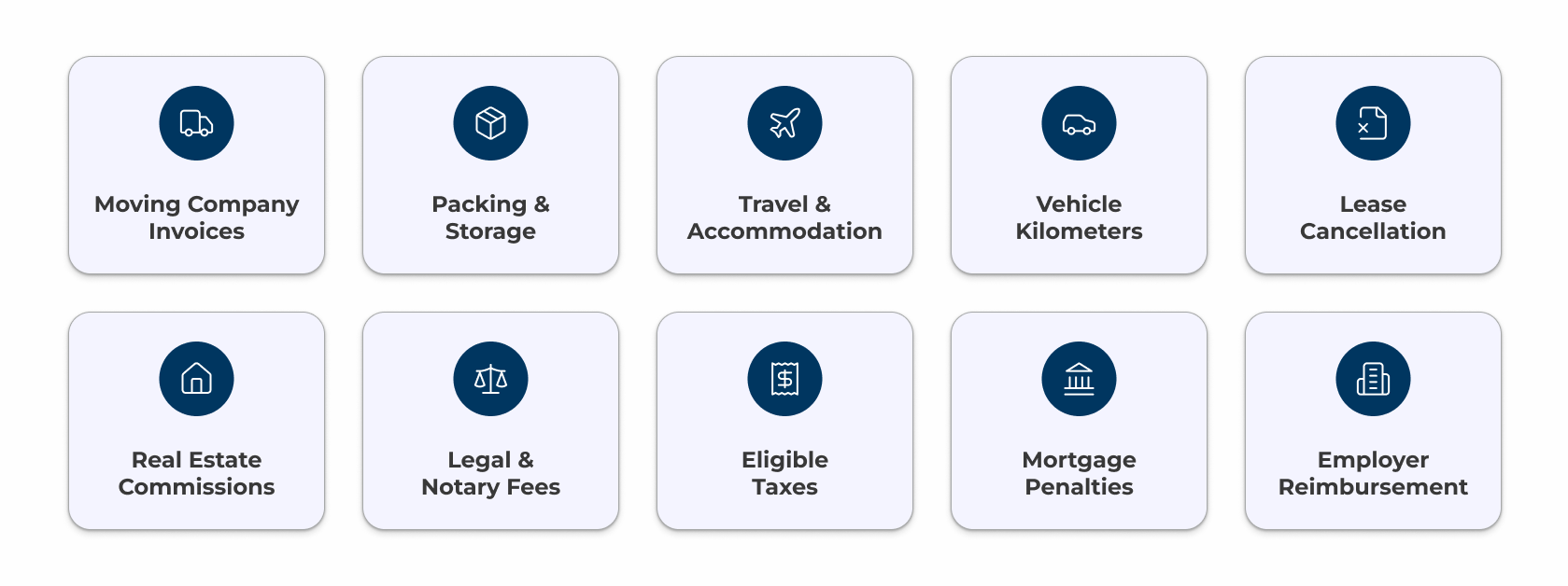
You do not submit all of your receipts with your return. However, the CRA requires you to keep supporting documentation in case it asks to review your claim later. Depending on your move, that could include:
- Moving company invoices Storage receipts, including records for qualifying in transit storage
- Travel records
- Accommodation receipts
- Vehicle kilometre records
- Lease cancellation documents
- Real estate commissions
- Legal bills and notary fees
- Records of eligible taxes paid
- Documentation for a qualifying mortgage penalty
- Employer reimbursement records
Even when you use the simplified method for certain expenses, the CRA may still request documentation supporting the move and your claim.
How Much Can You Claim for a Moving Expense Tax Deduction?
There is no single flat moving expense tax deduction available to every Canadian who qualifies. The amount is based on eligible moving expenses and depends on applicable CRA limits, reimbursements you received, and the amount of net eligible income you earned at your new location.
For employees and self-employed individuals, your deduction is limited to the employment or self-employment income earned at your new work location. Some individual expense categories have additional limits.
For example, the CRA allows eligible temporary living expenses for a maximum of 15 days. Certain costs of maintaining your former home while it is vacant, such as property taxes, insurance premiums, interest, heating, and utilities, may qualify up to a maximum of $5,000, provided the CRA’s conditions are satisfied.
Other expenses need to be distinguished carefully. For example, eligible legal or notary fees related to a qualifying transaction may be deductible, while mortgage default insurance and certain household appliances costs are not.
If your qualifying expenses are greater than the eligible income you earned at your new location, you may not necessarily lose the remaining deduction.
The CRA says that certain unused moving expenses may be carried forward and deducted against the same type of eligible income earned at the new location in a future year. That is one reason it can be important to look beyond a single tax return when reviewing a significant relocation.
Common Questions About Moving Expense Tax Deduction
Yes, you may be able to claim moving expenses from your Canadian income taxes if your relocation meets CRA requirements.
For employees and self-employed individuals, that means moving to work or operate a business at a new location, earning qualifying income there, and establishing a new home that is at least 40 kilometres closer to the new work location . Simply moving to another home for personal reasons does not qualify.
There is no universal amount that everyone can deduct. Your moving expense deduction depends on your actual expenses that are eligible, applicable limits, employer reimbursements, and the qualifying income you earned at the new work location.
Certain categories also have their own limits, including the 15-day limit for eligible temporary living expenses and the maximum $5,000 claim for qualifying costs of maintaining a vacant former home .
Potentially, yes. Canadian employees and self-employed individuals may qualify when moving for a new work or business location and meeting the CRA’s requirements. Certain full-time post-secondary students may also qualify under separate rules .
The reason for your move, distance between your residences and work or school, type of income earned, and nature of your expenses all matter.
Depending on your circumstances, eligible moving expenses can include moving and storage costs, transportation and storage costs, travel to your new residence, temporary accommodation, lease cancellation costs, certain expenses related to selling your former home, qualifying costs of purchasing your new home, and certain incidental costs.
Depending on the transaction, eligible selling or purchasing expenses may also include commissions, notary fees, certain legal fees, a qualifying mortgage penalty, and specified taxes .
However, expenses such as house-hunting trips, job-search travel, renovations to make your old home more saleable, mortgage default insurance, certain household appliances costs, and losses on the sale of your former residence do not qualify.
Get Help Claiming Your Moving Expense Tax Deduction
Moving expenses can look straightforward until you start working through the details.
Did your move pass the 40-kilometre test? Which real estate expenses qualify? How should an employer reimbursement be treated? What happens if your eligible moving expenses exceed the income earned at your new work location?
The situation can become even more complicated when a spouse or common-law partner sold a former residence, not all household members moved at the same time, or the relocation involves employment, self-employment, or student income.
For employees, business owners, and self-employed Canadians with more complicated relocations, getting those details right can make a meaningful difference.
At Advanced Tax Services, our experienced CPA team will review your relocation as part of your broader tax situation. We’ll help determine which moving expenses qualify, review reimbursements and supporting documentation, calculate your available deduction, and ensure the appropriate amounts are reported accurately on your Canadian tax return.
If part of your deduction cannot be used in the current year, we’ll also help you understand whether eligible amounts will carry forward and how they may affect future returns.
You paid enough to make the move. Make sure you understand which expenses will help reduce your taxable income. Book a meeting with our CPA team to review your moving expenses and understand what you can claim.