What Is a Capital Loss in Canada?
Nobody likes selling an investment for less than they paid. But here’s the good news: that loss can still help you at tax time.
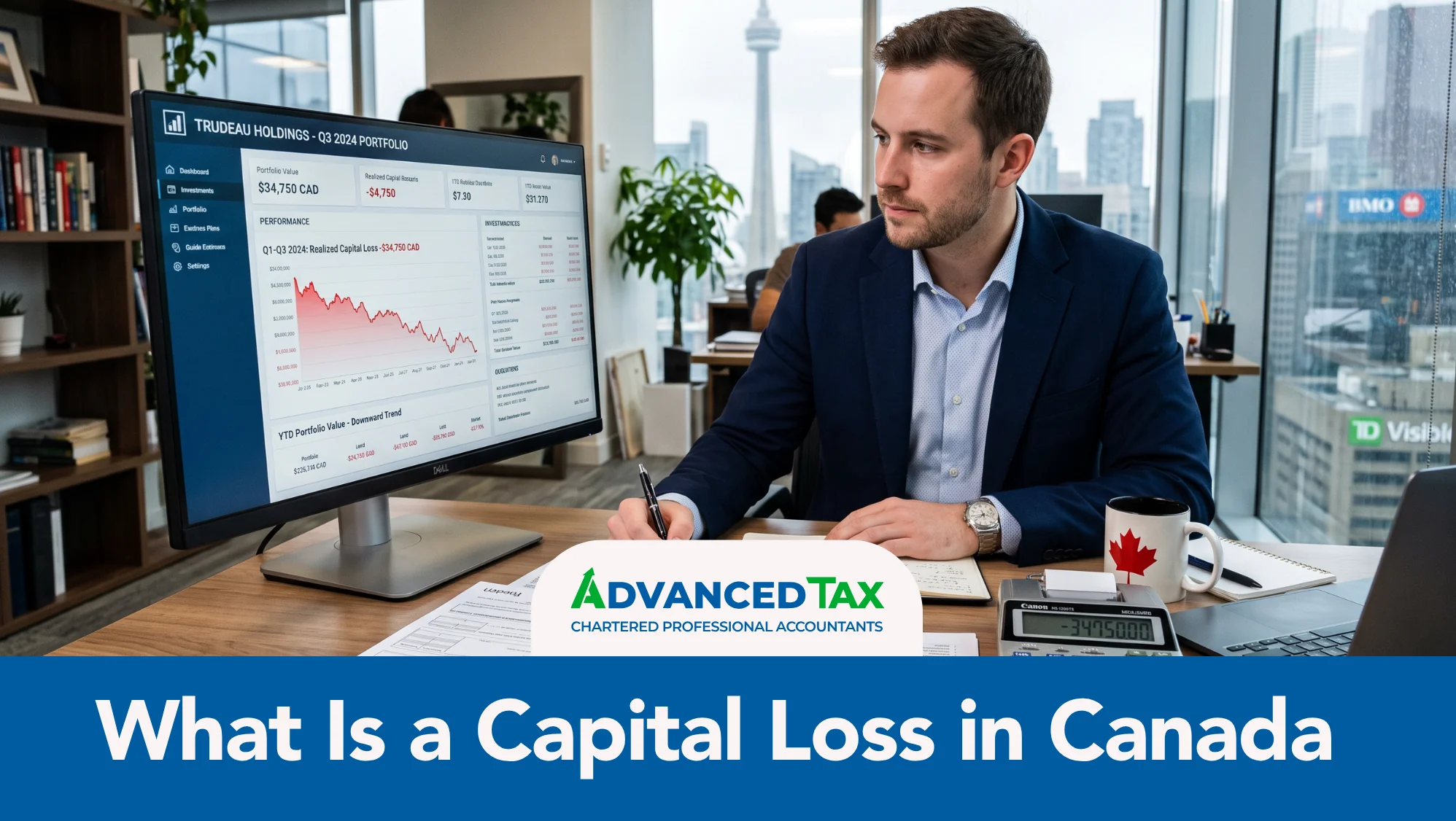
So, what is a capital loss? It happens when you sell or give away something like stocks, mutual funds, crypto, or a rental property for less than it cost you, including the fees to buy and sell it.
You can use that loss to lower the tax on your capital gains, whether those gains happened this year, in the past three years, or years from now.
As Azim Dahya, CPA at Advanced Tax Services explains:
“A lot of people sell at a loss and think that’s the end of it. It isn’t. That loss can lower your tax this year, get you money back from past years, or be saved for when you need it in the future.”
Below, we’ll explain how capital losses work, how to use them in other years, and the rules that can trip you up.
What Is a Capital Loss?
The Canada Revenue Agency (CRA) says you have a capital loss when you sell something for less than its adjusted cost base (ACB), plus any costs to sell it. Your ACB is basically what you paid, including fees like commissions.
For example, say you bought shares for $20,000 and later sold them for $15,000. Leaving out fees, that’s a $5,000 capital loss.
Only half of that loss is used for tax. This half is called your allowable capital loss, so your $5,000 loss becomes a $2,500 allowable capital loss. The same 50% rule applies to gains, so only half of a capital gain is taxed.
Capital losses can only be used against capital gains. You can’t use them to lower the tax on your paycheque or business income. But when you do have gains, a loss can cut the tax you pay on them.
Plenty of Canadians have gains to offset. In 2021, about 12% of all tax filers reported capital gains, according to Statistics Canada.
Here’s how gains and losses compare:

Some losses don’t count. If you sell personal items, like your car or furniture, for less than you paid, the CRA treats that as a personal expense. Losses inside an RRSP or TFSA don’t count either, since gains in those accounts aren’t taxed. That’s worth knowing: more than 19 million Canadians had a TFSA in 2024, according to the CRA.
You might also hear about tax-loss selling, or tax-loss harvesting. That’s when you sell investments that have dropped in value so you can use the loss against your gains. It can work well, but watch out for the superficial loss rules, which we explain below.
To use a loss on your 2026 tax return, the sale has to settle by December 31. Since trades now settle the next business day, that means selling by about December 30, 2026.
Net Capital Loss: When Losses Are Bigger Than Gains

A net capital loss is what’s left when your allowable capital losses are bigger than your taxable capital gains for the year.
Say you had a $10,000 loss and a $4,000 gain this year. After the 50% rule, that’s a $5,000 allowable loss and a $2,000 taxable gain. The loss wipes out the gain, and the remaining $3,000 becomes your net capital loss.
The CRA says you have to use your losses against this year’s gains first. Only what’s left over counts as a net capital loss.
The good news? That leftover amount doesn’t disappear. You can use it in past or future years, which we cover next.
Keeping track of your losses is part of good personal tax planning, especially if you buy and sell investments over several years. Your unused net capital losses are shown on your notice of assessment, the summary the CRA sends after you file. Losses from 2000 or earlier may need to be adjusted, because a different share of gains was taxed back then.
Capital Loss Carryforward: Save It for a Future Year

A capital loss carryforward lets you save an unused net capital loss and use it against taxable capital gains in a future year.
There’s no expiry date. Under current rules, you can carry a net capital loss forward for as long as you need.
Let’s say you end 2026 with a $3,000 net capital loss and no gains to use it on. Then in 2029, you sell some shares for a $6,000 taxable capital gain. You can use your $3,000 loss that year, so you only pay tax on $3,000 of the gain.
You also get to choose how much to use and when. You claim it on line 25300 of your tax return, and you can apply just enough to cover a year’s gains and save the rest.
One more rule worth knowing: in the year someone passes away, their unused net capital losses can be used against other types of income, not just capital gains.
That’s why it pays to think beyond one tax year. Keep track of your past losses so you can use them when gains come along.
Capital Loss Carryback: Get Money Back From Past Years

A capital loss carryback works the other way. Instead of saving your loss for later, you use it on gains you’ve already paid tax on.
The CRA lets you carry a net capital loss back up to three years.
For example, a net capital loss from 2026 can be used against taxable capital gains from 2023, 2024, or 2025. Say you had a $3,000 net capital loss in 2026 and a $3,000 taxable capital gain in 2024. Carrying the loss back cancels out that gain. If your tax rate that year was 30%, you’d get about $900 back.
To do this, fill out Form T1A, Request for Loss Carryback, and send it with your tax return. You don’t need to change your old return. The CRA updates it for you.
Not sure whether to carry a loss back or forward? Carrying it back puts money in your pocket now. Carrying it forward can make more sense if you expect bigger gains later. Check your last three returns before you decide.
Capital and Non Capital Losses: What’s the Difference?

Capital and non capital losses sound alike, but the CRA treats them very differently. If you own a business or rental property, it helps to know which is which.
A capital loss comes from selling an investment or property for less than you paid. As we covered above, it can only lower your capital gains.
A non-capital loss usually comes from a business or rental property that loses money. If that loss is bigger than all your other income for the year, what’s left becomes a non-capital loss.
For example, say your new side business loses $20,000 in its first year and you have no other income. That $20,000 becomes a non-capital loss, which you can use to lower your income in other years.
The CRA lets you carry non-capital losses back three years or forward up to 20 years. That’s different from net capital losses, which never expire.
This gets trickier if your business or corporation has both types of losses in the same year. Our corporate tax services team can help you sort out which losses go where and how to use them.
Is There a Capital Loss Tax Deduction?
Sort of. People often call it a capital loss tax deduction, but it doesn’t work like most deductions. A regular capital loss can’t lower the tax on your salary or business income. It only lowers capital gains.
You report your gains and losses on Schedule 3 when you file your tax return. That form works out your taxable gains or your net capital loss for the year.
There’s one big exception for business owners. If you invest in a small Canadian private company and lose money on its shares, or on a loan you made to it, you may have a business investment loss. Half of that loss, called an allowable business investment loss (ABIL), can be deducted from any type of income, not just gains.
For example, say you put $40,000 into a friend’s small business and it fails. You could deduct $20,000 from your other income, like your salary.
You may also hear about the Lifetime Capital Gains Exemption (LCGE), but it’s a different thing. A capital loss lowers the tax on your gains. The LCGE lets some business owners, farmers and fishers sell qualifying shares or property and pay no tax on up to about $1.25 million of gains in their lifetime. It has its own rules, which we’ll cover in a separate guide.
ABILs come with strict rules, so it’s worth having a CPA look at them, especially if you also file a corporate tax return.
Not sure how your losses fit together? Our CPA team can review your gains, losses and past returns to make sure nothing gets missed.
Superficial Loss Rules: The 30-Day Catch
Here’s a rule that trips up a lot of investors. If you sell an investment at a loss and buy it back too soon, the CRA won’t let you claim the loss right away. This is called a superficial loss.
It applies if you, or someone affiliated with you, buy the same investment within 30 days before or after you sell it, and still own it 30 days after the sale. That’s a 61-day window in total.
For example, say you sell 100 shares of a bank stock on December 10 for a $2,000 loss. Then you buy them back on December 20 because you still like the company. That $2,000 is a superficial loss, so you can’t claim it this year.
The good news is that the loss isn’t gone for good. It gets added to the cost of the shares you bought back, so when you sell them later, your gain will be smaller or your loss bigger.
Who counts as affiliated? Mainly your spouse or common-law partner, a company you or your partner control, and partnerships or trusts you have a major stake in. So buying the shares back in your spouse’s account won’t get around the rule. Buying them back in your own TFSA or RRSP won’t either, and in that case the loss is gone for good.
Want to stay invested while you harvest a loss? Wait at least 31 days before buying back the same investment, or buy something similar, but not identical, in the meantime.
Common Questions About Capital Losses
It’s a loss from running a business or renting out property, rather than from selling an investment. Unlike a capital loss, it can lower almost any kind of income. If your business loses more than you earn from everything else, you can carry the difference back three years using Form T1A, or forward up to 20 years by claiming it on line 25200 of your return.
Start by reporting the sale on Schedule 3 when you file your tax return, including what you paid and what you sold it for. Keep your trade confirmations or account statements as proof. Want to use the loss against gains from a past year? Add Form T1A. To use a loss from an earlier year against this year’s gains, claim it on line 25300.
Only against capital gains, in most cases. A regular capital loss won’t lower the tax on your paycheque, but it can cancel out tax on gains from this year, the past three years, or the future. The main exception is an allowable business investment loss, which can be deducted from any income. Since every situation is different, it’s worth checking with a CPA before you claim.
Get Help Managing Capital Losses and Your Taxes
Now that you know what a capital loss is, you can see it’s more than a one-year event. A loss you take today can lower your taxes this year, get you money back from past years, or help you years from now.
The tricky part is putting it all together. You might have gains from past years worth revisiting, old losses you forgot about, or business losses that follow different rules.
At Advanced Tax Services, our CPA team looks at your gains and losses as part of your whole tax picture. We’ll find the losses you can use, check your past three years for refund opportunities, and make sure everything is reported correctly.
If you own a business, we’ll also help you sort out capital and non-capital losses so each one works as hard as it can for you.
Book a meeting with our CPA team to find out how your capital losses can lower your taxes.