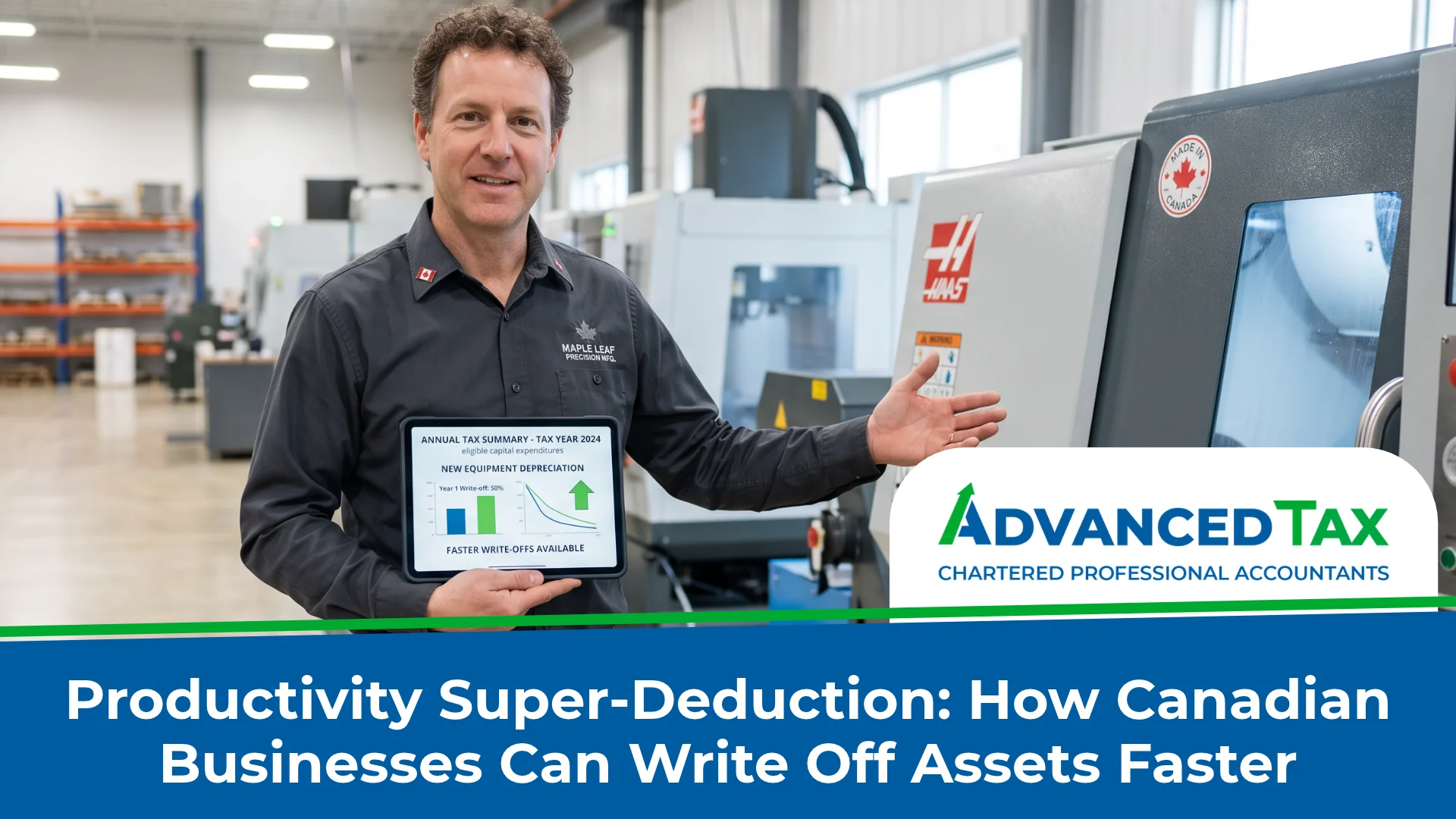
Productivity Super-Deduction: How Canadian Businesses Can Write Off Assets Faster
Thinking about a new delivery van, a CNC machine or a round of laptop upgrades for your team? The timing of that purchase could matter more at tax time than you think.
The productivity super-deduction is a set of federal tax rules from Budget 2025 that let businesses write off the cost of new assets much faster than usual. Some purchases can even be deducted in full in the first year. Normally, you’d spread that cost over many years through capital cost allowance (CCA), which is the tax version of depreciation.
You don’t get to deduct more in total with a faster write-off. More of the deduction lands up front, so you pay less tax now and keep more cash in the business when you need it most.
As Azim Dahya, CPA at Advanced Tax Services explains:
“A new machine or a new set of computers feels like a big expense. But the day you put it to work can change your tax bill by thousands of dollars. So plan the purchase and the taxes together, not after the fact.”
Below, we’ll explain what the productivity super-deduction covers, how much faster you can write off assets, the dates that matter, and how a new proposal announced in September 2026 could change things again.
What Is the Productivity Super-Deduction?
How the Accelerated Investment Incentive Works
Accelerated CCA: How Much Faster Can You Write Off an Asset?
Immediate Expensing: Writing Off 100% in Year One
Accelerated Capital Cost Allowance Timeline: Key Dates and Phase-Outs
Productivity Super Deduction Canada: How the New Mega Deduction Compares
How to Claim the Productivity Super-Deduction
Common Questions About the Productivity Super Deduction
Get Help Making the Most of the Productivity Super-Deduction
What Is the Productivity Super-Deduction?
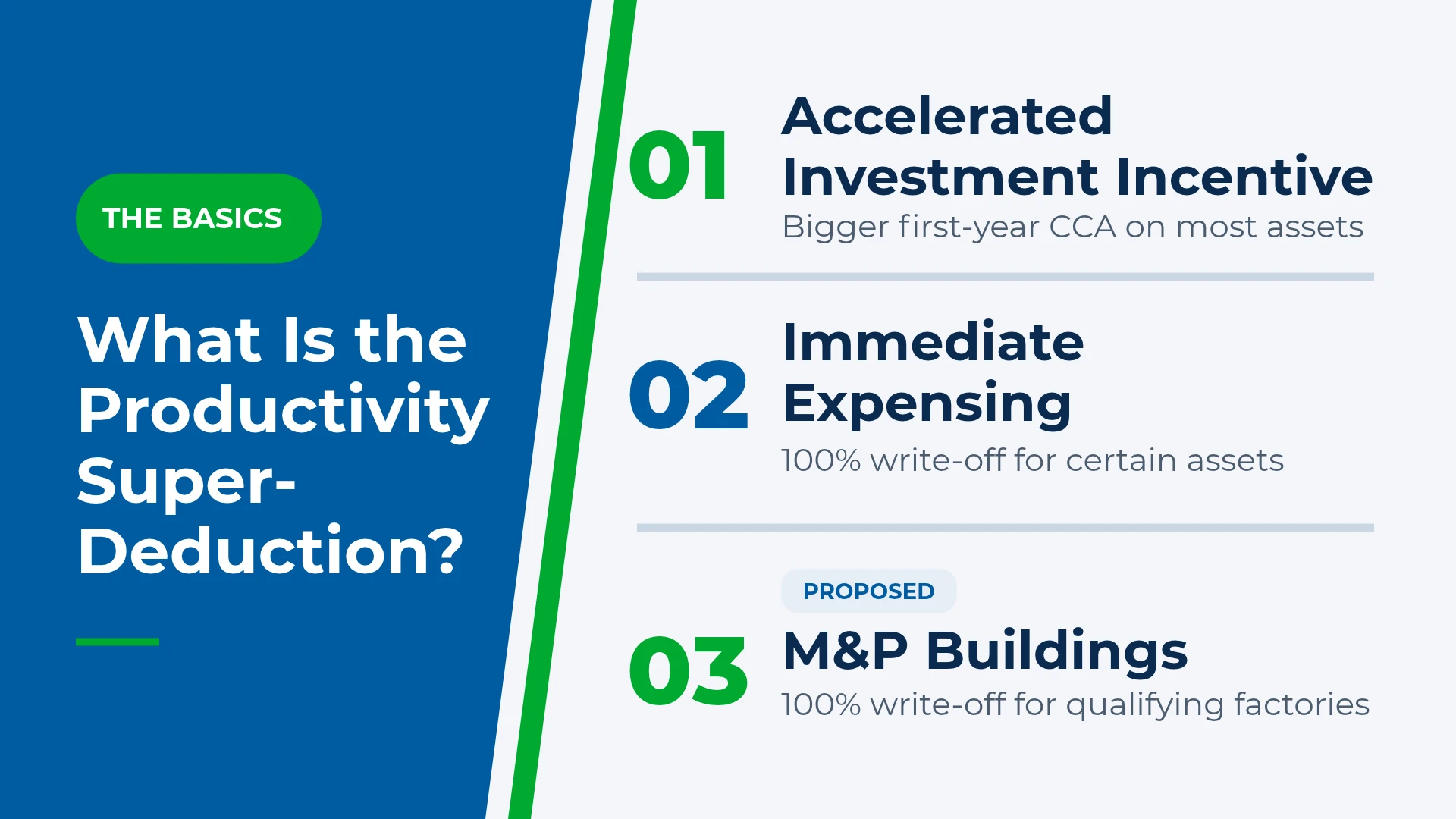
Despite the name, the productivity super-deduction is a package of faster write-off rules, announced in Budget 2025 on November 4, 2025.
It has three main parts:
The Accelerated Investment Incentive (AII): a bigger first-year CCA claim on most business assets.
Immediate expensing: a 100% write-off in year one for certain assets, like manufacturing machinery, clean energy equipment and zero-emission vehicles.
Immediate expensing for manufacturing and processing buildings: a new, proposed 100% write-off for qualifying factory and plant buildings.
Ottawa wants businesses to invest in tools that make them more productive, and it’s using the tax system to make that cheaper. According to the federal government, these measures cut Canada’s marginal effective tax rate on new business investment to 13.2%, down from 15.4% before the budget.
The marginal effective tax rate measures how much tax eats into the return on a new investment. Lower is better for you.
Most of these rules are now law. Bill C-15 received Royal Assent on March 26, 2026, which put the AII and most of the immediate expensing measures into effect. The building write-off is still before Parliament, which we cover below.
How the Accelerated Investment Incentive Works
Of all the pieces, the accelerated investment incentive touches the most businesses. It gives you a bigger CCA claim in the first year you use an asset, across most CCA classes.
It applies to qualifying property you acquired on or after January 1, 2025, that becomes available for use before 2034. Assets put into use before 2030 get the biggest boost.
Accelerated Investment Incentive Property: What Qualifies?
In plain terms, accelerated investment incentive property is most new business assets you buy and use to earn income. Think equipment, tools, furniture, vehicles, software and leasehold improvements.
There are a few catches. According to the CRA’s guidance on the AII, used property only qualifies if neither you nor someone closely connected to you, like a relative or a company you control, owned it before. Assets you move into your business from yourself or a related company usually don’t qualify either, such as equipment you transfer from a sole proprietorship into your new corporation.
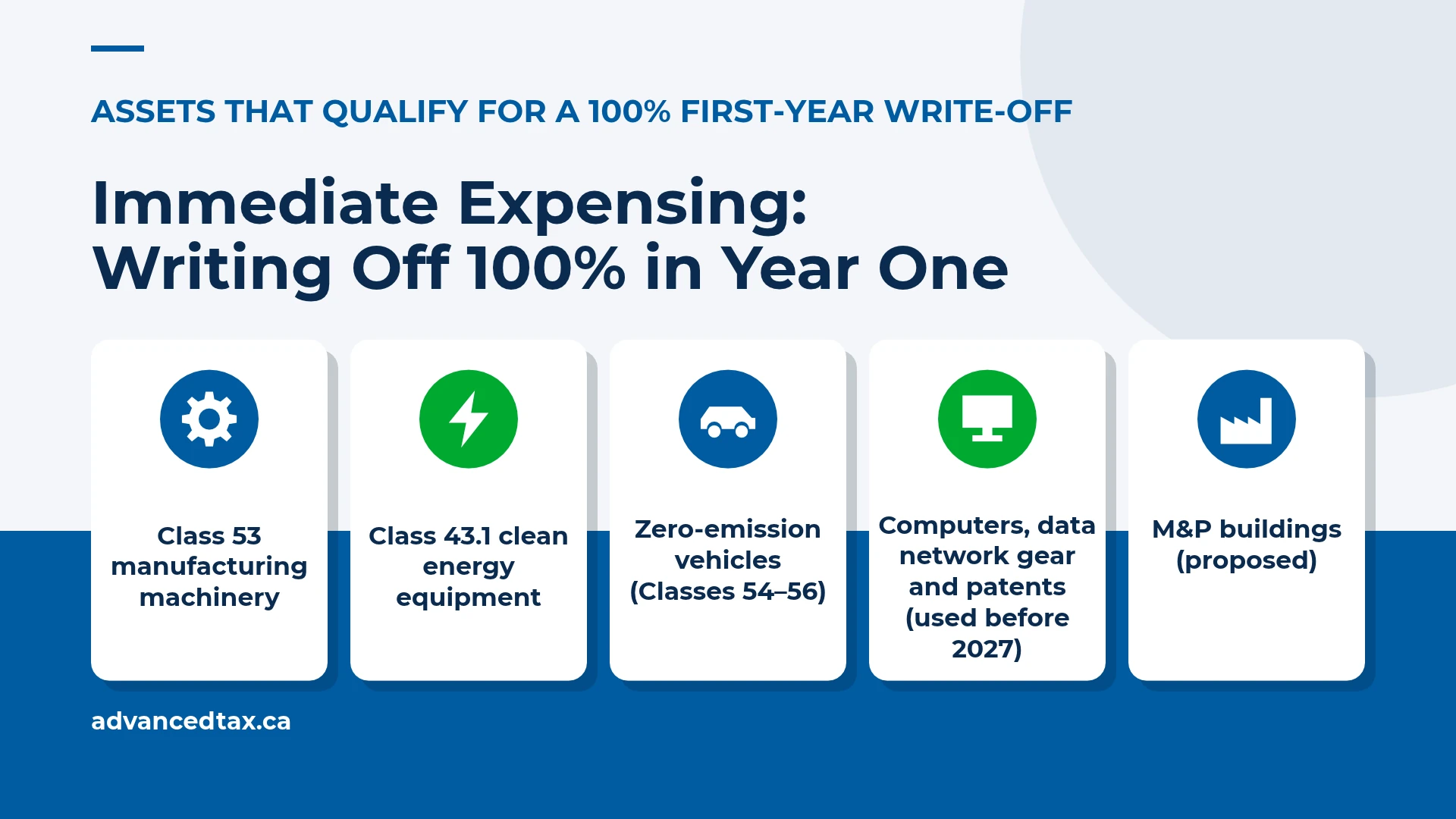
Some classes skip the AII because they get a full 100% write-off instead. That includes Class 53 manufacturing equipment, Class 43.1 clean energy equipment and zero-emission vehicles in Classes 54, 55 and 56.
How the AII Sets Aside the CCA Half-Year Rule
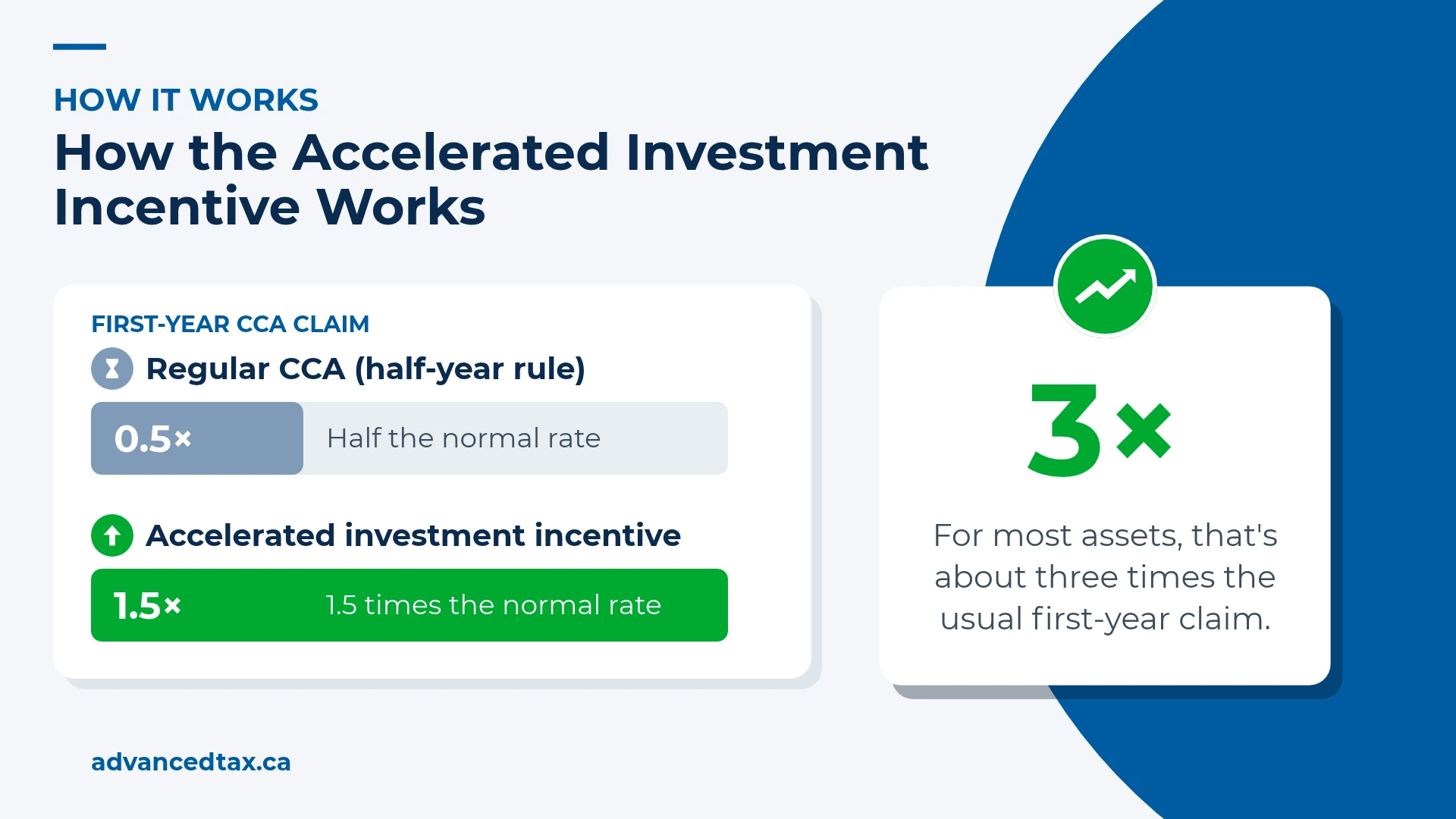
Normally, the CCA half-year rule lets you claim only half the usual CCA in the year you buy an asset, on the idea that you didn’t own it for the full year.
The AII sets that rule aside for qualifying property, then lets you claim 1.5 times the normal rate in year one. For assets that usually fall under the half-year rule, that works out to about three times the usual first-year claim.
The write-off is based on when an asset is “available for use,” not just when you pay for it. If you buy a machine in December but it isn’t installed and working until January, the bigger claim moves to next year. With a December 31 year-end, try to have it up and running before then.
Accelerated CCA: How Much Faster Can You Write Off an Asset?
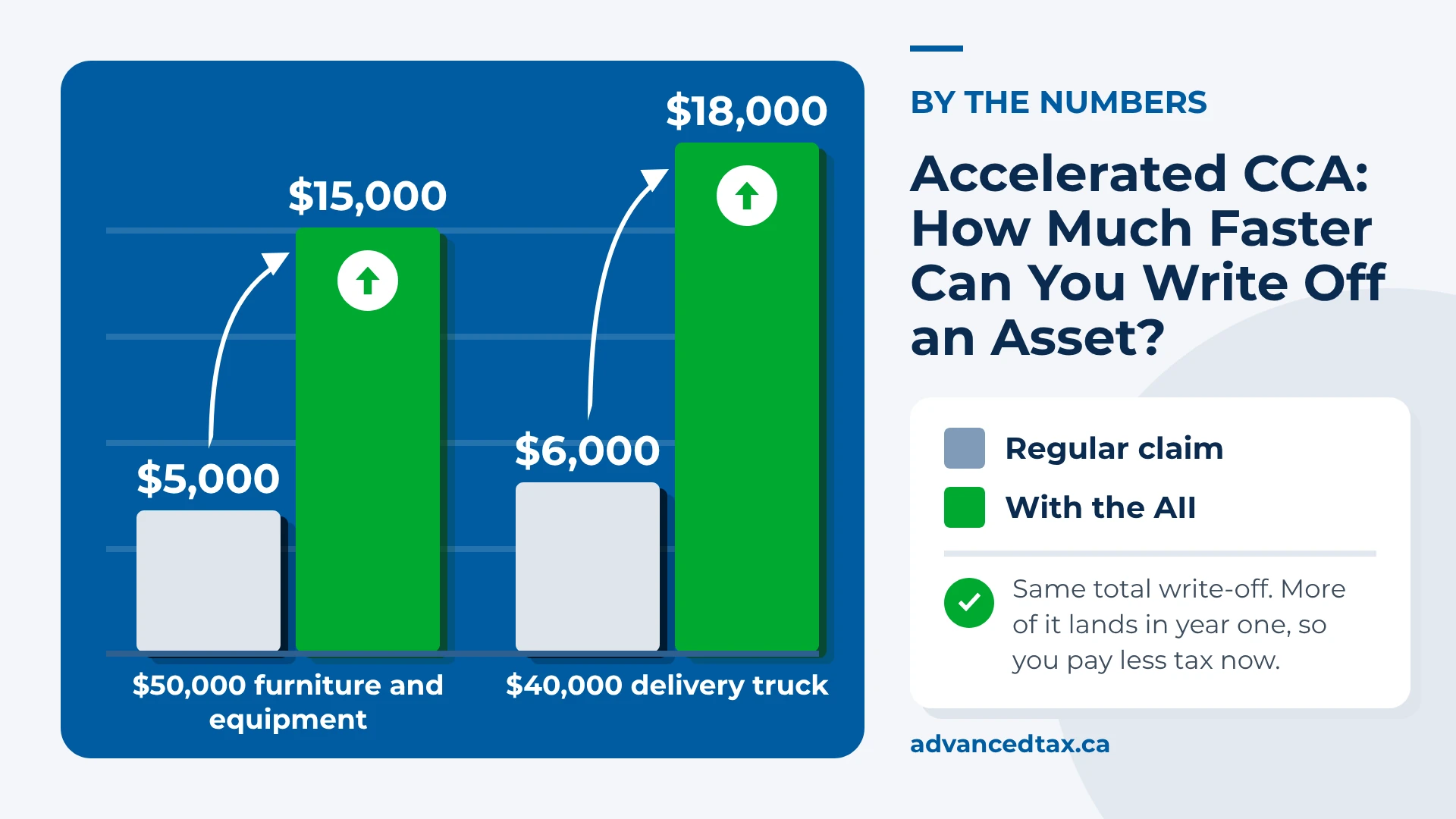
Here’s how accelerated CCA changes the first-year claim on a few common purchases.
| Asset | Cost | Regular claim | AII or expensing |
|---|---|---|---|
| Office furniture (Class 8) | $50,000 | $5,000 | $15,000 |
| Delivery truck (Class 10) | $40,000 | $6,000 | $18,000 |
| Factory machine (Class 53) | $200,000 | $50,000 | $200,000 |
The furniture and truck get the AII. The factory machine gets immediate expensing, a full 100% write-off.
Take the truck. Under the regular rules, you’d claim 30% of $40,000, then cut it in half because of the half-year rule. That’s $6,000. With the AII, you claim 1.5 times the 30% rate on the full cost, or $18,000.
For a small Ontario corporation paying the combined 12.2% small business rate, that extra $12,000 deduction means about $1,460 less tax this year. A larger corporation at the 26.5% general rate saves closer to $3,180.
Over the life of the asset, the total write-off stays the same, so your CCA claims in later years will be a bit smaller.
Not sure which CCA class your purchase falls into? We hear that question a lot, and the answer affects how much you can claim. It’s a good reason to keep your purchase invoices organized and your business records up to date.
Immediate Expensing: Writing Off 100% in Year One
Immediate expensing is the headline part of the productivity super-deduction. Instead of a bigger first-year claim, you write off the entire cost of a qualifying asset in the year you start using it. Here are the CCA classes eligible for immediate expensing, starting with the one most manufacturers care about.
Class 53 CCA: Manufacturing and Processing Machinery
Class 53 CCA covers machinery and equipment used mainly in Canada to manufacture or process goods for sale or lease. Think production lines, packaging machines, industrial ovens and CNC equipment.
If you bought Class 53 property on or after January 1, 2025, and put it into use before 2030, you can deduct 100% of the cost in year one. Say you’re a small food manufacturer and you buy a $200,000 packaging line in 2026. You can deduct the full $200,000 on your 2026 return. In Ontario, that’s about $24,400 in tax savings at the 12.2% small business rate, or about $53,000 if your income is taxed at the 26.5% general rate.
Immediate Expensing for Manufacturing and Processing Buildings
This is the newest piece and, for some businesses, the biggest. Buildings are normally written off very slowly. Even a qualifying factory gets only 10% a year, cut in half in the first year, so a $1 million building would give you just $50,000 in year one.
Under the proposed rules, a qualifying manufacturing or processing building acquired on or after November 4, 2025, and used for that purpose before 2030 could be written off 100% in the first year. Additions and alterations can also qualify. That same $1 million building would give you a $1 million deduction instead of $50,000.
To qualify, at least 90% of the building’s floor space has to be used for manufacturing or processing. If that use drops below 90% later on, some of the deduction can be added back to your income.
This measure isn’t law yet. It’s part of Bill C-31, which was still being studied in committee as of October 2026, so talk to a CPA before you commit to a building purchase or expansion.
Other Assets That Get Immediate Expensing
Manufacturers aren’t the only ones who benefit. Immediate expensing also applies to:
Clean energy and energy-saving equipment (Class 43.1), like solar panels and some heat recovery systems
Zero-emission vehicles (Classes 54, 55 and 56), such as electric work vans and trucks
Patents, data network gear and computers (Classes 44, 46 and 50), for property acquired after April 15, 2024, and available for use before 2027
A big write-off can push your business into a loss for the year. A corporation can usually carry that loss back three years for a refund of tax already paid, or forward up to 20 years. Since you don’t have to claim the maximum CCA, run the numbers before you decide how much to take.
Planning a big equipment purchase? Our corporate tax accountants can help you time it and pick the right CCA class, so you know what you’ll save before you buy.
Accelerated Capital Cost Allowance Timeline: Key Dates and Phase-Outs
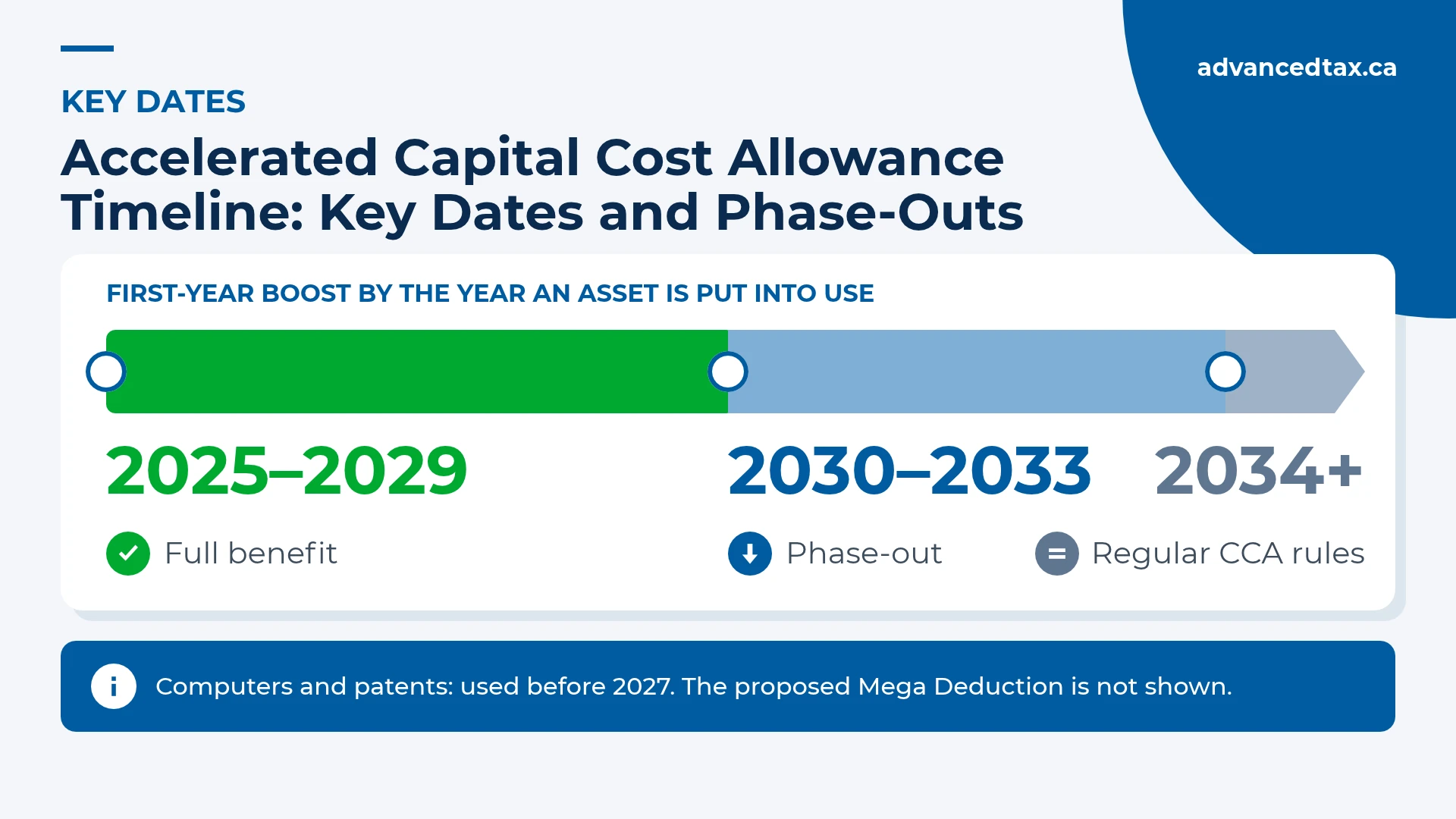
Accelerated capital cost allowance won’t last forever under the super-deduction rules. Most of the boosts stay at full strength until the end of 2029, then shrink each year until they’re gone after 2033. The building write-off, for example, drops to 75% for 2030 and 2031, then 55% for 2032 and 2033. (The proposed Mega Deduction, covered next, would change this for newer purchases.)
| Measure | Full benefit | Phase-out | Status (Oct. 2026) |
|---|---|---|---|
| AII | Used before 2030 | 2030 to 2033 | Law |
| Class 53, 43.1 and ZEVs | Used before 2030 | 2030 to 2033 | Law |
| M&P buildings | Used before 2030 | 2030 to 2033 | Proposed |
| Computers and patents | Used before 2027 | None | Law |
If you’ve been putting off an upgrade, the next few years offer the biggest write-offs. A $200,000 factory machine put into use in 2029 can be written off in full that year. Wait until 2032, and the first-year write-off drops to about $110,000.
Productivity Super Deduction Canada: How the New Mega Deduction Compares
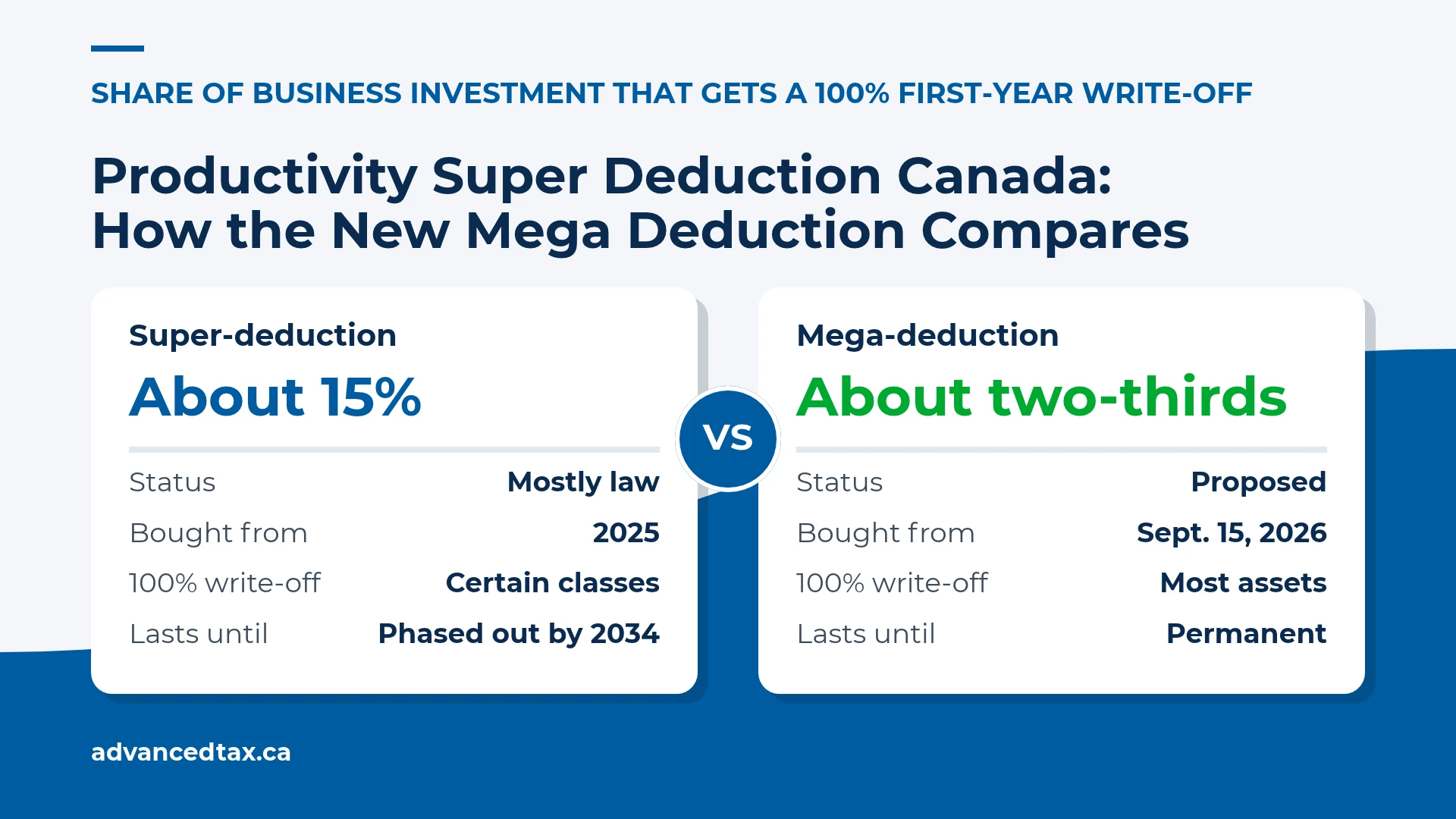
Just as businesses were getting used to the productivity super-deduction, Ottawa proposed something even bigger. On September 15, 2026, the government announced the Productivity Mega Deduction.
The super-deduction offers immediate expensing on about 15% of business investment. The Mega Deduction would extend 100% first-year write-offs to about two-thirds of it, for most assets bought on or after September 15, 2026, and make them permanent. The government says that would cut Canada’s marginal effective tax rate on new investment from 13% to 6.4%.
| Super-deduction | Mega Deduction | |
|---|---|---|
| Status | Mostly law | Proposed |
| Applies to | Bought from 2025 | Bought from Sept. 15, 2026 |
| 100% write-off | Certain classes | Most assets |
| Lasts until | Phased out by 2034 | Permanent |
Some assets would be left out, like most buildings, goodwill and certain passenger vehicles. Manufacturing buildings would keep the super-deduction rules, and anything that doesn’t qualify would still get the AII.
If you’re not incorporated, there’s a limit too. Individuals, trusts and partnerships with individual partners couldn’t use it to create or increase a loss, which matters if you file taxes as a sole proprietor.
It’s still a proposal, so plan around the rules already in place for now. We’ll cover the Mega Deduction in more detail in a separate guide.
How to Claim the Productivity Super-Deduction
You don’t apply for the productivity super-deduction separately. You claim it through your regular CCA schedule when you file.
Corporations claim CCA on Schedule 8 of the T2 corporate tax return.
Sole proprietors and partners claim it in the CCA section of Form T2125 (business) or T776 (rental).
A few steps make the claim go smoothly:
1. Confirm the CCA Class
Each asset goes into a CCA class with its own rate, and that class decides whether you get the AII, full immediate expensing or neither.
2. Record When It Was Available for Use
Hang on to delivery slips, installation records or anything else that shows when the asset was ready to work. That date sets the year you claim it in, and later on, which phase-out rate you get.
3. Decide How Much to Claim
You don’t have to take the full CCA. In a low-income year, claiming less and saving the rest for a year when you’re in a higher bracket can come out ahead.
4. File Any Elections on Time
If the building write-off becomes law, a manufacturing or processing building will need an election to go into its own class. It’s filed with your return for the year you start using the building, which makes it easy to forget, so put it on your year-end checklist.
For each big purchase, keep the invoice, proof of payment, the delivery or installation date, and a short note on what the asset is used for. Buying a building? Add a floor plan that shows the manufacturing space. Then if the CRA asks questions, everything is already in one folder.
Common Questions About the Productivity Super Deduction
Mostly. Bill C-15 became law on March 26, 2026, and with it came the AII and the 100% write-off for manufacturing machinery, clean energy equipment and zero-emission vehicles. The manufacturing building write-off is a different story: it sits in Bill C-31, which hadn’t passed as of October 2026. And the Productivity Mega Deduction, announced that September, is still only a proposal.
Yes, in many cases. Used equipment can qualify as long as neither you nor someone closely connected to you owned it before. For example, a used truck bought from a dealer would usually count. The same truck bought from your brother, or moved over from a company you control, usually wouldn’t. If you’re not sure, check before you buy, since it changes your first-year claim.
Yes. CCA is a maximum, not a requirement. If your business has a slow year, you can claim part of the write-off now and save the rest for later years, when it may save you more tax. Just keep in mind that the leftover amount is then written off at the class’s regular rate over time, not all at once.
The main ones are Class 53 for manufacturing machinery, Class 43.1 for clean energy equipment and Classes 54 to 56 for zero-emission vehicles, as long as they’re used before 2030. Classes 44, 46 and 50 qualify if they’re used before 2027. Not sure which class an asset belongs to? The CRA’s list of CCA classes is a good place to start, or ask your accountant before you buy.
Usually not. The building has to be used at least 90% for manufacturing or processing, and storing, shipping or selling goods generally doesn’t count. A plant with a small storage area could still qualify if most of the floor space is used for production. A standalone warehouse or distribution centre wouldn’t. If you’re planning a building project, check the floor plan against the 90% test early.
Get Help Making the Most of the Productivity Super-Deduction

Used well, the productivity super-deduction puts real money back into your business. How much depends on what you buy, when it goes into use, and whether the rule you’re counting on has actually passed.
Now that the Mega Deduction is also on the table, planning around the wrong rule is an easy mistake. One well-timed purchase can save thousands in tax, and if your year-end is December 31, you still have time to plan for 2026.
Our CPA team can go through your planned purchases with you, work out which CCA classes apply, and help you decide how much to claim and when. We’ll also watch Bill C-31 and the Mega Deduction so your plans stay current. You might also want to check whether your projects qualify for the SR&ED tax credit, or review our small business tax guide.
Book a meeting with our CPA team to find out how the productivity super-deduction could lower your business taxes.
—————————-